

Architecture
Blockcurr Architecture
Blockcurr Network is a high-performance, regulatory-grade layered architecture designed for real-world finance – powering tokenization, spot exchange and settlement, and interoperable asset rails. The platform supports both centralized and decentralized models in a hybrid configuration, so businesses can combine policy-controlled operations with open, on-chain transparency. Its architecture is organized into four layers that work together to deliver speed, reliability, and enterprise-class integration.
Blockchain Layer
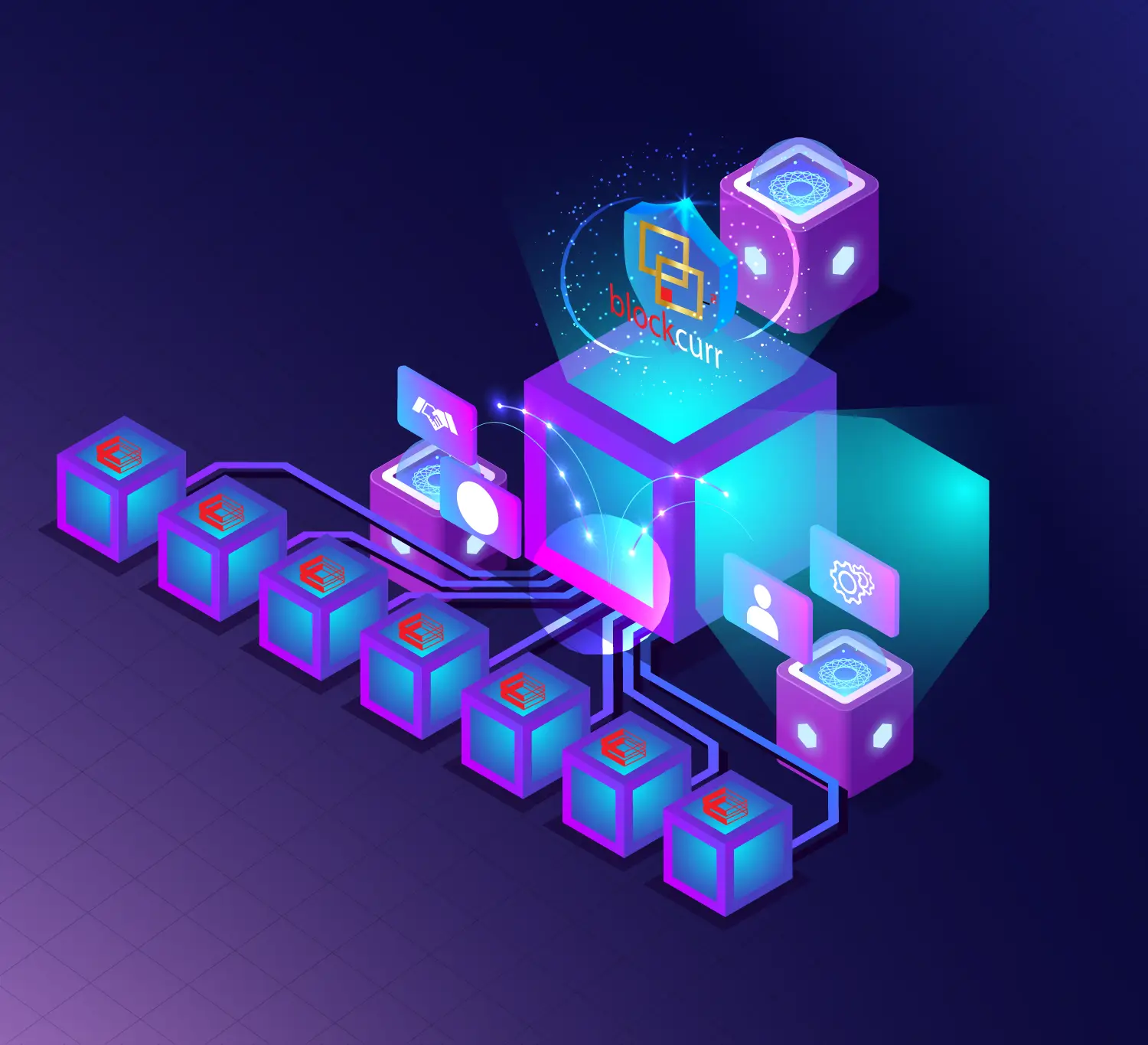
At the foundation, Blockcurr maintains a Merkle-committed state and append-only blocks with deterministic execution. Transactions and blocks propagate over an authenticated peer-to-peer network with peer scoring and DoS protections. State can be pruned for lean operation while optional archival nodes preserve full history, and snapshot/fast-sync keeps node bootstrapping quick. Deployments can be public, permissioned, or hybrid with validators, full/archival nodes, and edge topologies arranged to support both open participation and permissioned partitions where required.
Protocol Layer
Blockcurr couples Proof-of-Stake with fault-tolerant consensus for rapid, reliable finalization and manages the validator lifecycle (registration, staking/unbonding, slashing, rotation, key management) with epoch checkpoints for deterministic commits. Governance is modular and industry-tunable, supporting token-weighted DAOs, stake/validator-weighted voting, one-entity-one-vote consortiums, delegated/representative councils, and multisig boards with time-locks and emergency circuit breakers. These models can be mixed and scoped to permissioned segments or jurisdictions while the broader network remains decentralized, with optional observer/attestation roles for regulators.

Services Layer
Applications run on a deterministic, resource-metered on-chain execution engine – think built-in rules and automation – that is language-agnostic at the platform level. Interoperability is native via bridges and cross-chain messaging (attested or light-client models), oracle hooks, and event relays. Developers integrate through JSON-RPC and WebSocket endpoints for transactions, blocks, and logs; REST for system metadata; and optional indexing/graph services. A service registry, rate-limited endpoints, and policy hooks support hybrid operations, from custodial, centrally orchestrated services to non-custodial, fully on-chain decentralized exchange (DEX) and decentralized-finance (DeFi) features.
Application & Integration Layer
Blockcurr offers standards-based interfaces including JSON-RPC, WebSocket, and REST APIs so developers can connect using any language or framework (Java, Python, TypeScript, Go, .NET, Rust, or even low/no-code tools). While Blockcurr provides a complete full-stack environment for tokenization, custody, and exchange, it also supports integration with external blockchains such as Ethereum, Bitcoin, and Solana. This ensures interoperability for payments, liquidity access, and asset transfers, allowing institutions and developers to interact seamlessly with existing ecosystems and user bases. First-party SDKs (JavaScript/TypeScript, Python, Java) simplify wallet, custody, and exchange operations, while connectors integrate banking/payment rails, HSM/KMS custody, analytics, and compliance pipelines. Developers can build solutions for tokenized financial instruments including stablecoins, treasuries, and commodity-backed assets along with spot markets, instant settlement, and on-chain treasury operations. The architecture supports both custodial and non-custodial wallets, offering flexible deployment: centralized UX with regulated oversight, decentralized UX with user-held keys, or a hybrid model that combines control and autonomy in a single product.
Disclaimer: The Blockcurr Network materials are provided for informational purposes only and do not constitute investment, legal, accounting, or tax advice, nor an offer, solicitation, or recommendation to buy or sell any security, token, or other financial instrument. Any examples of tokenized assets or applications (e.g., stablecoins, precious metals, equities, supply-chain assets) are illustrative and do not imply availability, approval, listing, or performance. Availability of products, services, and features depends on jurisdiction and counterparty readiness, and may require licensing, registrations, and completion of KYC/AML and other compliance reviews. Digital assets are volatile and involve risk, including loss of value and, in some cases, total loss. Custody and wallet services (if provided) are not bank deposits and are not insured by the FDIC, SIPC, or any government agency. Security and performance characteristics (e.g., “fast finality,” throughput, uptime) are design goals and depend on network conditions, validators, and third-party infrastructure; they are not guarantees. While Blockcurr employs multi-layer controls and industry-standard cryptographic practices, no system can be completely secure. Cross-chain bridges, oracles, and external integrations introduce additional operational and counterparty risks. This page may contain forward-looking statements (e.g., “plan,” “expect,” “aim,” “will”). Actual results may differ materially due to regulatory, technical, market, and operational factors. Blockcurr assumes no obligation to update such statements. References to third-party tools or services are for convenience and do not constitute endorsement or warranty.
Jurisdiction-specific notices and additional terms may apply.