
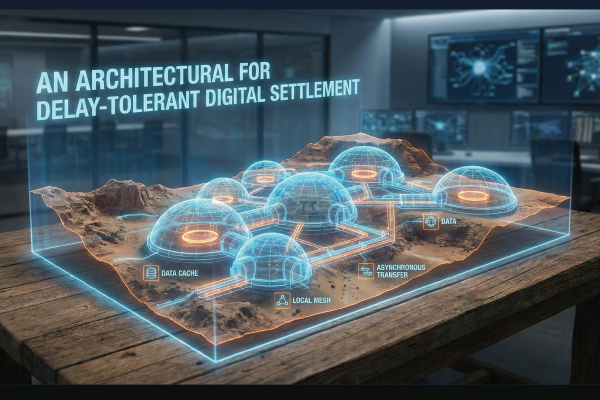
An Architecture for Delay-Tolerant Digital Settlement
Modern digital asset markets rest on a powerful but fragile assumption: constant internet connectivity. Networks like Bitcoin and Ethereum were built for always-on environments where transactions are broadcast globally, validated in real time, and settled through continuous consensus. When connectivity drops, finality stops.
At the heart of today’s digital market dependency lies the consensus mechanism. Digital exchanges rely on distributed consensus to establish a single authoritative transaction history, prevent double-spending, enforce deterministic trade ordering, and preserve market integrity even under adversarial conditions. Continuous validator communication is not incidental; it underpins price discovery, liquidity coordination, and custodial trust. When connectivity degrades, validators cannot synchronize, ordering becomes uncertain, and the guarantees of finality begin to erode. If the network pauses, finality pauses.
The physical economy operates differently. Commerce is inherently delay-tolerant. Trade persists across remote geographies, during outages, and amid fragmented communication environments. Goods change hands, obligations are recorded, and trust is maintained through social contracts and asynchronous reconciliation. Economic exchange does not require constant global synchronization; it tolerates temporary inconsistency so long as eventual settlement is possible.
This contrast exposes a structural fragility in most digital asset systems: commercial continuity is tightly coupled to uninterrupted bandwidth. Connectivity, rather than economic intent, becomes the gating factor for transaction finality.
The Web5 Protocol (W5P) is built on a different premise: in many environments, mobility outperforms connectivity. Instead of depending on continuous global broadcast, W5P separates transaction execution from final settlement. Transactions execute within trusted local domains and are encapsulated into Cryptographic State Artifacts (CSAs). These artifacts are portable, tamper-evident containers of economic state and can be stored on-device, transferred peer-to-peer, and independently verified without live network access. As participants and devices move, CSAs propagate across fragmented or intermittent networks and synchronize with a global settlement ledger once reliable connectivity is restored.
W5P draws conceptual inspiration from Delay/Disruption Tolerant Networking (DTN), pioneered in research programs supported by NASA, where data moves through store-and-forward routing rather than continuous end-to-end connections. W5P extends this architectural principle to financial state progression. While still evolving, its central thesis is clear: digital value should not be immobilized by imperfect connectivity.
Cryptographic State Artifacts (CSAs)
CSAs exhibit the following characteristics:
- Addressing: Cryptographic hash of the complete artifact
- Purpose: Portable proof of economic state and value
- Embedded Rules: Ownership, spend constraints, and domain governance logic
- Offline Propagation: Designed for device-to-device transfer
- Finality Model: Immediate local execution, eventual global settlement
- Double-Spend Protection: Deterministic constraints embedded within state
- Incentive Model: Rewards aligned with reliable delivery to settlement
Once created, CSAs move through what W5P defines as transit-native pathways. Mobility itself becomes the transport layer. Artifacts may propagate via Bluetooth, Wi-Fi Direct, NFC, enterprise LAN clusters, local mesh networks, temporary hotspots, or through the physical movement of devices. Each verified transfer increases redundancy and survivability.
When a device reconnects to the local network or the internet, it submits accumulated CSAs to the global settlement layer. Settlement is state-aware: CSAs that represent the most current and cryptographically valid progression of state settle immediately upon verification. The global layer performs canonical ordering, deterministic conflict resolution, and governance enforcement only where competing or stale states exist. In other words, settlement does not recompute execution; rather, it confirms the latest valid state.
Execution therefore remains local and instantaneous, while settlement is authoritative and conditional. If conflicting CSAs surface, predefined governance logic resolves them algorithmically based on deterministic rules embedded in state progression. Security derives from architectural state constraints rather than continuous broadcast or computational intensity.
A central challenge in offline finance is double-spend prevention. Rather than relying on instant global visibility, W5P embeds spend limits, replay protection, and domain-scoped constraints directly within the state artifact. Because each CSA carries a verifiable lineage, the most recent valid state supersedes prior versions. Invalid or outdated artifacts fail settlement deterministically.
Incentives shift accordingly. Instead of rewarding raw computation or staked capital, W5P aligns rewards with reliable custody, propagation, and timely delivery of valid state to settlement nodes, prioritizing resilience over energy expenditure. This incentive layer remains under active refinement.
The implications are significant: digital trading in low-connectivity regions, operational continuity during disasters, and censorship-resistant commerce at the edge of infrastructure. W5P reframes digital finance as mobility-aware and physically grounded, where connectivity accelerates value movement but is not required, and the most current valid state settles without delay.
Web3 vs Web5 Key Differentiators
| Feature | Web3 | Web5 |
| Primary Goal | Decentralize infrastructure and execution | Decentralize identity & data ownership, and trust |
| Storage | Public blockchains and distributed file systems (e.g., IPFS) | Personal Decentralized Web Nodes (DWNs) under user control |
| Connectivity | Always-on networks and continuous cloud availability | Ambient persistence with offline-first operation |
| Currency | Token-centric ecosystems (e.g., ETH, SOL) | Token-agnostic; value exchange is optional, not required |
Web5 Protocol (W5P) Core Foundations
The Web5 Protocol (W5P) provides the architectural foundation for this shift by establishing a user centric trust stack. Rather than anchoring identity and data to platforms or applications, W5P is built around four core primitives that place control directly in the hands of individuals.
Decentralized Identifiers (DIDs)
Decentralized Identifiers are self sovereign digital identifiers owned and managed by users. They are anchored minimally to a blockchain solely for cryptographic trust and key resolution, not for data storage or application logic. This removes dependence on centralized identity providers while preserving verifiability and security. Identity becomes portable, persistent, and independent of any single platform.
Decentralized Web Nodes (DWNs)
Decentralized Web Nodes are personal, user controlled data nodes that act as private data hubs. They store personal information, application state, credentials, and permissions under the user’s control. Data is shared directly between parties according to explicit authorization rules, without reliance on centralized servers or data brokers. Users decide who can access their data, for how long, and for what purpose.
Verifiable Credentials (VCs)
Verifiable Credentials are cryptographically signed digital attestations such as proof of age, qualifications, or permissions that can be selectively disclosed. Rather than exposing raw personal data, users present only the minimum information required to establish trust. This enables compliance, verification, and accountability while preserving privacy by design.
Decentralized Web Applications (DWAs)
Decentralized Web Applications are built on the DID, DWN, and VC stack. They operate as distributed systems rather than platform hosted services and are not bound to any single blockchain or cloud provider. Because identity and data live with the user, applications become interchangeable, resilient, and capable of functioning even when connectivity is limited or unavailable.
Concrete Outcomes of a User-Centric Trust Model
- Identity Without Custodianship: Traditional exchanges depend on centralized identity providers, shared credentials, and repeated KYC submissions. Under a Web5-influenced model, the exchange verifies identity without owning it. Identity becomes portable, reusable, and independent of any single platform.
- Privacy-Preserving Compliance: Exchanges often overcollect and permanently store sensitive personal data. By relying on verifiable credentials rather than raw documents, regulatory compliance is maintained while unnecessary data exposure is eliminated.
- User-Owned Financial History: Trade records are typically confined to exchange databases and lost when accounts are closed or platforms change. With user-controlled records, individuals retain durable, verifiable ownership of their transaction history across platforms and time.
- Continuity in Low-Connectivity Environments: When connectivity is lost, traditional trading systems halt, even if counterparties are present. A transit-aware model allows commerce to proceed locally, with settlement completed once connectivity is restored.
- Portable, Policy-Aware Compliance: Exchanges struggle to dynamically enforce jurisdiction-specific rules as users move across regions. When compliance attributes travel with the user, policy enforcement becomes consistent, contextual, and location aware.
- Resilient Exchange Applications: Most exchange applications are tightly coupled to backend infrastructure, creating single points of failure. By shifting core trust and authorization functions to the edge, exchange applications become resilient, adaptive, and tolerant of partial outages.
The Broader Implication
Web5 reorders the digital stack. Identity comes first. Data follows identity. Applications become transient interfaces rather than permanent custodians of trust. By separating identity and data from platforms and networks, W5P enables systems that are more private, more resilient, and more aligned with how people actually move and interact in the physical world. Trust is no longer granted by platforms. It is carried, verified, and enforced cryptographically by the user. This is not an extension of Web3. It is a new foundation for the web built around individuals rather than infrastructure.
The protocol remains under active development, with select Web5 Protocol (W5P) capabilities being incrementally introduced within the exchange applications. While the full architecture continues to evolve, the underlying principle is clear. Digital value does not require perfect connectivity to move. In a transit native system, settlement may be delayed, but commerce continues uninterrupted.The protocol remains under active development, with select Web5 Protocol (W5P) capabilities being incrementally introduced within the exchange applications. While the full architecture continues to evolve, the underlying principle is clear. Digital value does not require perfect connectivity to move. In a transit native system, settlement may be delayed, but commerce continues uninterrupted.
Disclaimer:
The Web5 Protocol (W5P) is a forward-looking concept under active research and development. It is not finalized or deployed as production financial infrastructure, and its design and governance may change. This article is for informational purposes only and does not constitute legal, investment, or regulatory advice, or an offer of any securities or financial instruments. Forward-looking statements involve uncertainties, and actual outcomes may differ materially.